

A narrow side passage can be one of the most difficult areas of a property to secure. There may be limited room between the house and boundary fence, uneven ground, drainage concerns or obstacles that prevent a standard gate from opening properly. Choosing the wrong design can make everyday access frustrating, even when the gate looks attractive.
A carefully planned side gate installation in Melbourne can help homeowners improve privacy, manage access to the backyard and create a more practical boundary without taking up unnecessary space. The key is to select a gate that suits the passage width, ground conditions, fencing layout and way the space is used.
For homeowners considering a Side Gate for Narrow Side Passages, the best solution is not always the smallest gate or the most expensive-looking material. It is the design that opens reliably, provides suitable security and remains practical to maintain.
This guide explains how to plan a side gate for a narrow passage, compare common gate styles, choose suitable materials and avoid installation problems. With practical guidance from New Look Landscaping & Service, you can better understand what to consider before making a decision for your Melbourne home.
A gate that works well across a wide backyard entrance may not be suitable for a tight side passage. Limited clearance affects the opening direction, hinge position, access and available installation space.
For example, imagine a passage between a brick house wall and a timber boundary fence. A conventional hinged gate might swing into the passage and block most of the walking area. If bins, garden tools or outdoor equipment are stored there, opening the gate could become awkward.
Another property might have a sloping concrete path. A gate that sits too close to the ground could scrape against the surface whenever it opens.
These situations show why measurements and site conditions should guide the design rather than appearance alone.
Assessing these factors before installation helps reduce avoidable adjustments later.
A practical gate begins with an accurate assessment of the available space. Measuring only the distance between two posts is not enough; the surrounding area also determines how the gate will operate.
Measure the width between the intended fixing points at more than one height. Existing posts may not be perfectly vertical, and fences can shift or lean over time.
Also consider the space required for the frame, hinges and latch. The usable opening may be narrower than the total distance between the walls or posts.
Check the height as well. A taller gate may provide more privacy, but it must suit the existing fence and any applicable property or planning requirements.
Look along the passage for slopes, raised paving, garden edging, drains and changes in surface level.
A small change in ground height can make a noticeable difference to gate operation. Where the path slopes, the gate may need a different opening direction, adjusted bottom clearance or a suitable design that avoids contact with the ground.
Do not simply leave a large gap underneath without considering the purpose of the gate. Excessive clearance can reduce privacy and may be unsuitable where the gate is intended to contain pets.
Drainage also matters. A gate should not obstruct water flow or create a point where leaves and debris collect.
Consider what normally travels through the area.
A passage used mainly for pedestrian access has different requirements from one used to move wheelbarrows, gardening equipment or bulky outdoor items. The gate should provide a usable opening for these everyday activities.
Think about where the gate will be opened from, whether the latch can be reached comfortably and whether the surrounding space allows the gate to be secured without difficulty.
A strong gate can still perform poorly if its hinges are attached to an unstable post or unsuitable fence section.
Check whether existing posts are firm, straight and appropriate for the gate’s weight. A lightweight fence panel may not provide enough support for a heavier gate without reinforcement.
Where a new post is required, its position and foundation should be planned around the ground conditions and intended gate design.
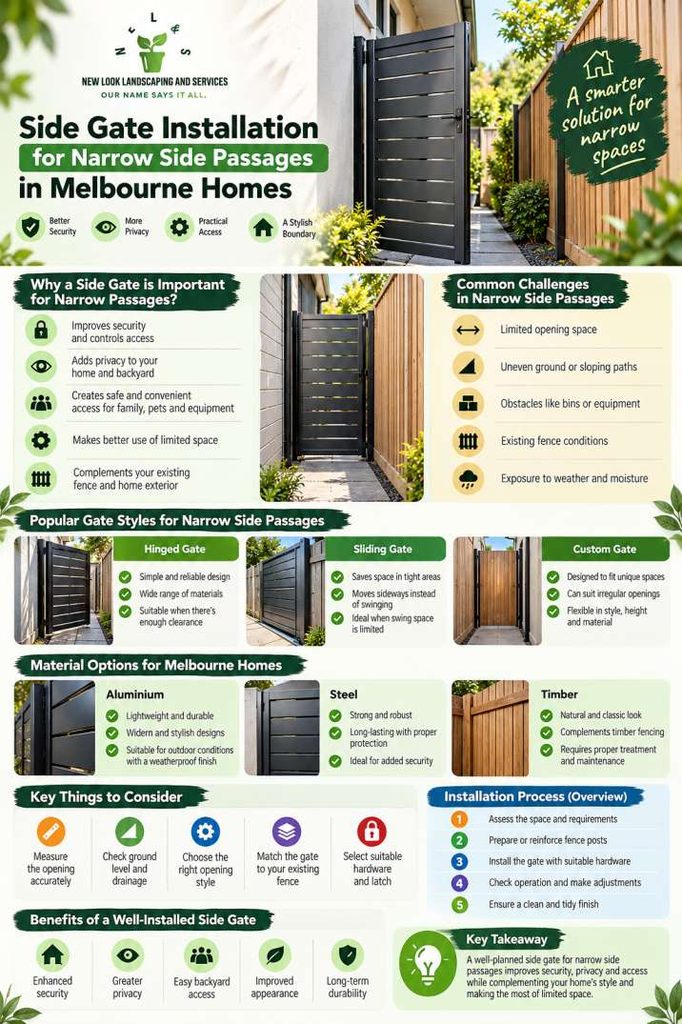
The opening mechanism is one of the most important decisions for a narrow passage. A suitable design can preserve walking space, reduce obstruction and make access easier.
A hinged gate is a practical option when there is enough room for the gate to swing open. It has a straightforward design and can be made from different materials to suit the property’s fencing.
Before choosing this style, determine whether the gate will open inward or outward. An inward-opening gate may obstruct the passage, while an outward-opening gate could interfere with another access area or public space. The opening direction must be appropriate for the property and any applicable requirements.
Hinged gates are worth considering when the passage has sufficient clearance and the supporting posts can carry the gate securely.
A sliding gate moves sideways rather than swinging into the passage. This can be useful when there is little room for a hinged design.
However, a sliding gate needs clear space alongside the opening for the gate panel to travel. Rails, rollers or other guiding hardware must also suit the site conditions. Debris, uneven surfaces and poor alignment can affect movement if the system is not designed and maintained appropriately.
For very narrow passages, sliding may not be the best choice if a wall, downpipe or fence corner blocks the gate’s travel path.
A custom gate can be useful when the opening is unusually narrow, the walls are not parallel or existing fencing creates awkward fixing points.
The design can be adjusted to suit the available width, required height and surrounding materials. A custom gate should still allow comfortable access and reliable operation; making the panel as narrow as possible is not necessarily the best outcome.
For a Side Gate for Narrow Side Passages, the goal is to balance the available space with practical access, rather than forcing a standard gate into an unsuitable opening.
A backyard gate should suit the way the outdoor space is used. For a narrow side passage, consider whether the gate needs to provide privacy, restrict access for pets, improve boundary security or simply separate the backyard from the side access area.
A solid panel may offer greater privacy, while an open or slatted design can allow airflow and visibility. The gate should also provide enough clearance for people and everyday equipment to pass through without difficulty.
Before choosing a design, consider the gate’s weight, opening mechanism, latch position and compatibility with the existing fence. The best option balances convenient access with the practical needs of the household.
| Gate type | Main advantage | Main limitation |
|---|---|---|
| Hinged gate | Straightforward design and familiar operation | Requires swing clearance |
| Sliding gate | Does not swing into the passage | Needs space alongside the opening |
| Custom gate | Can suit irregular or restricted openings | Requires careful measurement and planning |
The material affects the gate’s appearance, weight, maintenance needs and long-term performance. It should also complement the existing fence and exterior of the house.
Aluminium is often considered for contemporary homes because it is relatively lightweight and available in a range of styles and finishes. Its lower weight can be helpful where the design needs to minimise the load on hinges and supporting posts.
Choose a suitable exterior-grade finish and ensure that hinges, screws, latches and other fittings are compatible with the gate material.
Steel can provide a solid, robust gate when appropriately designed and protected. Its weight and corrosion protection need particular attention, especially in areas exposed to moisture.
A suitable coating, sound fabrication and appropriate maintenance can help protect the surface. Scratches or damaged coatings should be addressed according to the manufacturer’s recommendations.
Timber can complement timber fencing, established gardens and homes with natural exterior finishes. It can also provide a more private barrier when designed with closely spaced boards.
Timber may respond to moisture and changing conditions by swelling, shrinking or moving. The frame, fixings, timber treatment and ground clearance should therefore be considered carefully. A timber gate that is too heavy or poorly supported may become difficult to open over time.
A suitable weatherproof finish helps protect the gate from outdoor exposure, but no finish makes every material maintenance-free.
When comparing options, consider:
Melbourne properties can experience changing weather, so a gate should be selected for the actual exposure at the site. A sheltered passage may have different needs from an area that receives driving rain or strong afternoon sun.
A gate is part of a larger boundary system. The surrounding fence, posts and fixing points all influence how well it operates.
When planning side gate fence installation in Melbourne, inspect the existing boundary before deciding whether to reuse it or make changes.
Look for loose posts, leaning panels, cracked timber, corroded metal and signs of movement around the proposed opening. A new gate attached to an unstable fence may sag or become misaligned.
If the existing fence needs repair or reinforcement, account for that work during planning rather than treating it as an afterthought.
A gate does not have to be identical to the fence, but its height, colour, spacing and overall proportions should look intentional.
For example, a dark aluminium gate may suit a contemporary fence, while a timber gate may blend more naturally with an existing timber boundary. The design should also consider visibility through the gate, particularly where privacy is important.
A gate can help control access to the backyard, but security depends on more than the panel itself. The latch, hinges, fixing points and surrounding boundary all matter.
Choose hardware that suits the intended use. If children or pets use the backyard, consider whether the latch is appropriate and whether gaps or openings present a concern.
A gate should not be described as fully secure simply because it has a lock. The surrounding fence, installation quality and actual site conditions also affect its effectiveness.
The side gate installation cost in Melbourne depends on the requirements of the individual property. A reliable estimate should reflect the gate design, materials, installation conditions and any additional work needed to make the opening suitable.
Rather than comparing quotes by the gate panel alone, check what each proposed installation includes.
For a narrow passage, the cheapest gate is not automatically the most economical choice over its useful life. A design that repeatedly catches on the ground or places excessive strain on its hinges can require adjustment or repair.
Ask for a clear breakdown of the proposed work so you can understand which materials, fittings and installation tasks are included. Avoid assuming that every quote covers repairs to the existing fence or changes to the ground surface.
Small details can make a significant difference to everyday use. Before finalising the design, consider how the gate will work in the context of the entire passage.
Measure the usable opening with the gate installed, not just the space before installation. Posts, hinges and latches can reduce the available width.
Think about the widest items that need to pass through. A gate that allows a person through comfortably may still be awkward for bins or garden equipment.
The latch should be easy to reach from the intended side and should not collide with a wall, post or nearby fitting. Check that the gate can close properly without needing to lift or force it.
If the gate is used frequently, straightforward hardware may be more practical than a complicated locking arrangement.
Outdoor gates need appropriate clearances to operate reliably. The necessary gap depends on the material, hinge design, ground surface and expected movement.
Avoid choosing clearances by guesswork. A suitable installer should assess the actual site and account for the gate’s weight, movement and surrounding surfaces.
Solid panels can provide more privacy, while slatted or open designs allow some airflow and visibility. The best choice depends on how the passage is used and whether overlooking, wind exposure or visual consistency is a concern.
A more enclosed gate may also collect more wind load than an open design. The frame, posts and fixings should be suitable for the selected panel style.
A gate can look suitable on paper but become inconvenient if important details are overlooked during planning.
A standard-sized gate may not fit an opening with uneven walls, leaning fence posts or restricted clearance. Measure the site first and confirm the usable opening, including space needed for the frame and hardware.
A gate installed too close to sloping ground can scrape whenever it opens. On the other hand, excessive clearance may compromise privacy or pet containment. The design should account for the ground profile rather than relying on a standard gap.
Gate weight places repeated loads on hinges and supporting posts. If a post is loose or unsuitable, the gate can gradually sag, making the latch difficult to engage. Inspect the support structure before installation.
Water that collects around a gate can contribute to corrosion, timber deterioration and slippery surfaces. Keep drainage paths clear and avoid installation choices that trap water or block existing drains.
A finish should suit the material and outdoor conditions. Consider how it will be maintained and how exposed hardware will hold up over time, rather than selecting a coating solely for its colour.
A few practical checks can help homeowners make a more informed decision before committing to a design.
For homeowners planning a new gate, New Look Landscaping & Service can be considered when exploring a suitable design for the property’s outdoor layout. The important starting point is a clear assessment of the opening, existing boundary and practical access needs.
Installing a gate in a narrow side passage requires more planning than simply finding a panel that fits between two boundaries. The opening direction, usable width, ground slope, fence condition, material and hardware all influence the final result.
A well-planned Side Gate for Narrow Side Passages should provide practical access, complement the existing fence and operate reliably under everyday conditions. It should also have a suitable weatherproof finish and allow for straightforward maintenance.
Before arranging a side gate installation in Melbourne, assess how the passage is used, measure the opening carefully and identify any restrictions around the proposed gate. These steps help you compare suitable designs and avoid common installation problems.
New Look Landscaping & Service can be part of your planning process as you consider a gate that suits your property’s layout and outdoor needs. The right choice is one that balances appearance, access, durability and practical use.
The best option depends on the available clearance and how the passage is used. A hinged gate can work well when there is enough room to swing it open. A sliding gate may be more practical when swing space is restricted, provided there is room for the panel to travel sideways. A custom design may be appropriate for an unusually narrow or irregular opening.
Measure the distance between the proposed fixing points at several heights, then check the height, ground slope and space around the opening. Account for posts, hinges and latch hardware because these can reduce the usable width. Also consider the items that need to pass through the gate. Where the opening is irregular, a site assessment can help establish the correct dimensions.
The main factors include the gate material, dimensions, opening mechanism, supporting posts, existing fence condition and ground profile. Custom fabrication, additional reinforcement and finishing requirements can also affect the overall cost. Request a clear scope of work so you can compare quotations on the same basis rather than looking at the gate panel alone.
Aluminium, steel and timber can all be suitable, depending on the property’s needs. Aluminium is relatively lightweight and available in modern designs. Properly protected steel can provide a robust structure, while timber can complement natural fencing and offer privacy. Consider maintenance, gate weight, moisture exposure, hardware compatibility and the appearance of the existing boundary before choosing.
It can, depending on the property, the gate’s location and its intended purpose. Boundary location, gate height, easements, pool safety obligations and other applicable rules may affect the design. Do not assume that a gate is exempt simply because it is small or located beside the house. Check the requirements relevant to the specific property before work begins.
New Look Landscaping and Service precisely love to work among greens and make the surrounding special with artistic features. We are specialised in design concepts, constructions and management for multiple outdoor spaces around Victoria.